
Key takeaways
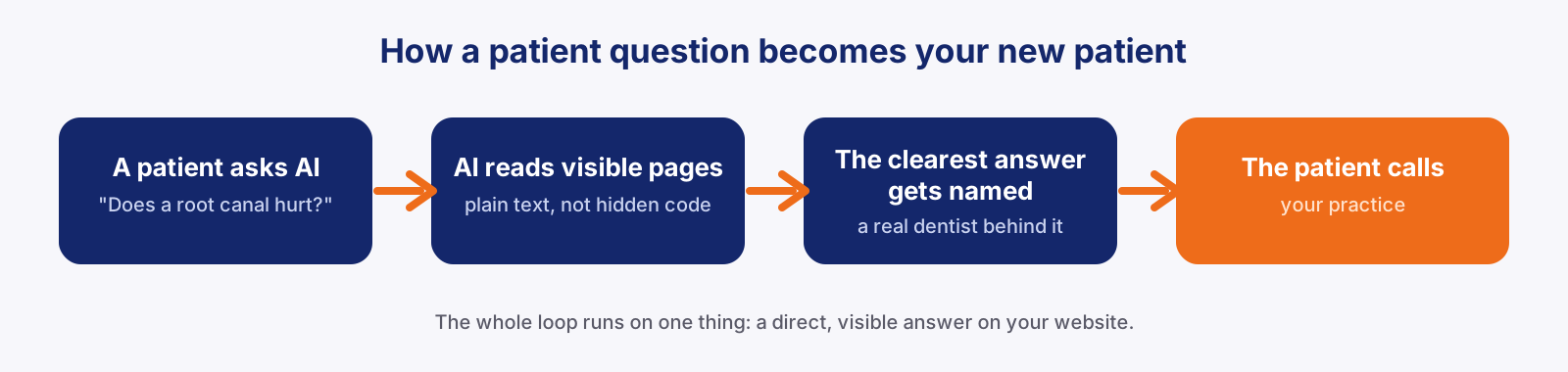
- Patients now ask AI assistants the questions they used to type into Google, and the practices that get named are the ones whose websites answer those questions directly.
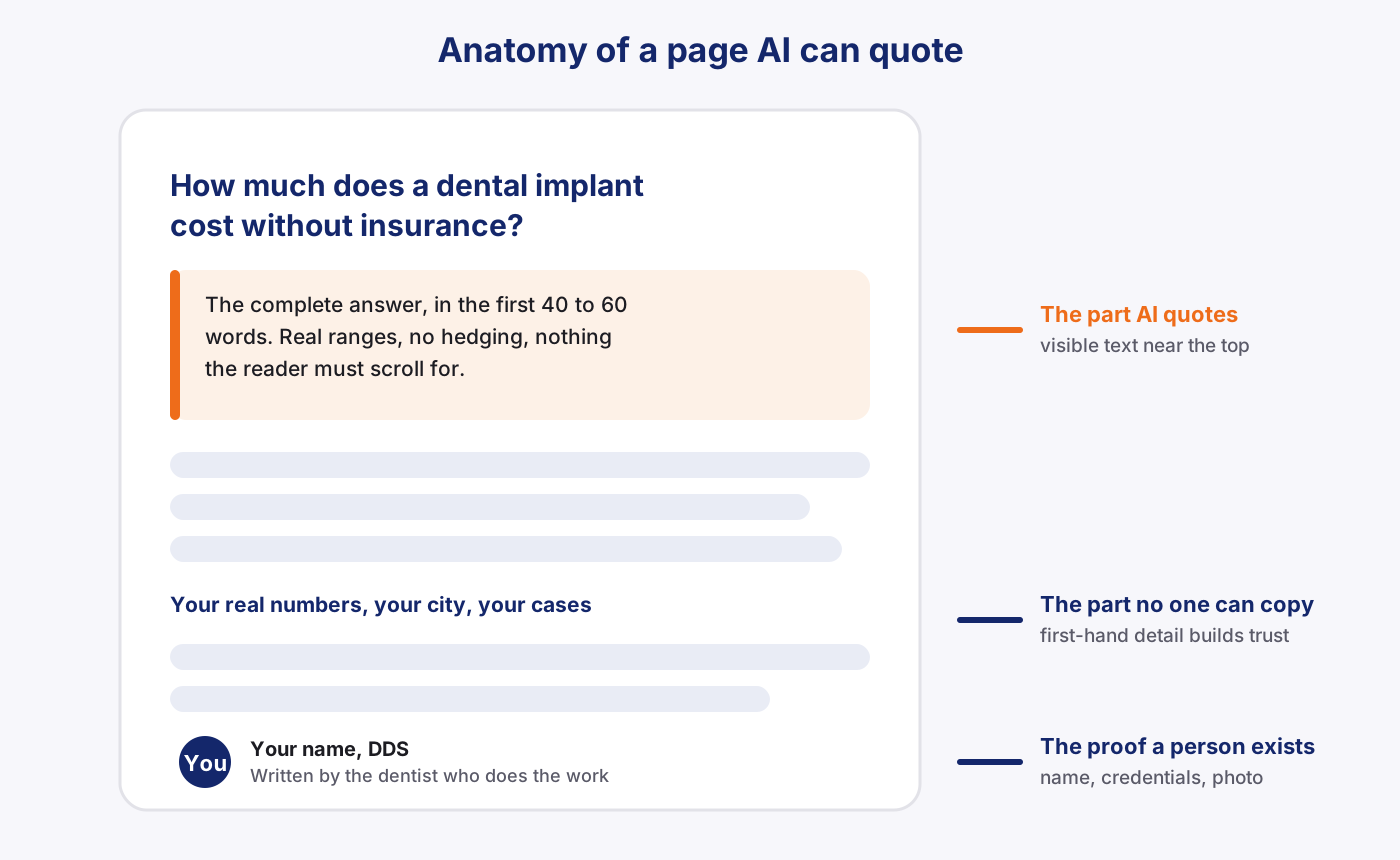
- Put a complete 40 to 60 word answer at the top of every page. AI engines quote visible text, and the first clear answer usually wins.
- Your own numbers, cases and local details are the only content a competitor cannot copy and an AI cannot invent.
- Keep your practice name, address and services identical on your website and your Google Business Profile, so an engine can tell you are real.
In this guide
- What is GEO, and how is it different from SEO?
- Which questions should your practice answer first?
- How do you write an answer AI will quote?
- Where does AI check that your practice is real?
- How do you know if it is working?
- Common questions
What is GEO, and how is it different from SEO for a dental practice?
GEO stands for generative engine optimization. In plain English: making sure that when a patient asks ChatGPT, Perplexity or Google's AI a dental question, the answer comes from you, names you, or points at your practice. SEO tries to win a ranked list of links. GEO tries to win the single answer the assistant gives out loud. The two overlap, and nothing about GEO replaces having a healthy website. But they reward different writing, and the difference is easiest to see side by side.
| SEO | GEO | |
|---|---|---|
| The goal | Rank high in a list of links | Be the answer the AI gives |
| The first reader | A person scanning results | A machine reading your page |
| What wins | Keywords, links, site health | A direct, quotable answer from a named dentist |
| Where you appear | Page one of Google | ChatGPT, Perplexity, Google AI Overviews |
| How you measure it | Rankings and clicks | Your name and pages showing up inside AI answers |
If your practice already ranks decently, you are not starting over. You are adding a layer: pages that each answer one question, directly, in words a machine can lift and quote.
Which questions should your dental practice answer first?
Start with the questions patients say out loud, because those are the ones they now say to an AI assistant. Your front desk already knows every one of them. The four types below cover most of what a practice gets asked, and each maps to a page your website probably does not have yet.
| Question type | What a patient actually asks | Why AI tends to quote it |
|---|---|---|
| Cost | "How much does a dental implant cost without insurance?" | Honest cost pages with real ranges are rare, so a concrete answer stands out |
| Fear | "Does a root canal actually hurt?" | A named dentist's reassurance beats an anonymous forum thread |
| Urgency | "Is a cracked tooth an emergency?" | Urgent questions get asked at midnight, to a phone, in exactly these words |
| Comparison | "Veneers or bonding for a chipped front tooth?" | Comparisons match the shape AI answers naturally take |
Write one page per question, in the words the patient used. A page called Restorative Dentistry Services answers nothing. A page called How much does a dental implant cost in Miami answers something a real person asked, and it gives the AI a clean match the next time that question comes in.
How do you write an answer AI will actually quote?
Put the whole answer in the first 40 to 60 words, visibly, on the page. Not in a dropdown, not hidden in code, not after three paragraphs about the history of your practice. When searchVIU tested five AI systems in late 2025, every one of them read the visible text of the page during a live fetch, and none of them extracted a fact that existed only in hidden structured data. The text a patient can see is the text the machine quotes.
Specifics carry evidence too. The first controlled study of GEO, from researchers at Princeton and IIT Delhi, found that rewriting pages to include statistics, quotations and cited sources raised visibility in AI generated answers by roughly 25 to 40 percent on the study’s measures. Hold the exact numbers loosely: it was a lab benchmark built on an older model, not a live test of today’s engines. But the direction matches everything else we know. Concrete beats vague.
For a dental practice, concrete means your own details. What a crown costs at your practice. How many implants you placed last year. What you tell a nervous patient at a first visit. A competitor can copy your topics; they cannot copy your numbers. And one rule sits above all of it: answers are educational, never promises. No outcome guarantees, ever, and anything clinical ends with come in and let a dentist look at it.
Where does AI check that your practice is real?
Engines cross check. Before an assistant names a business, it has usually seen the same facts in more than one place: your website, your Google Business Profile, your reviews, local directories. If your site says Main Street Dental, your profile says Main St Dental Care, and the two disagree about your hours, the machine has a reason to pick a competitor it can verify instead. The fix is boring and free: identical name, address, phone and services everywhere, a Google Business Profile with the right category, and service pages on your own domain that match what the profile claims.
How do you know if it is working?
Measure it the way a patient would. Once a month, ask ChatGPT, Perplexity and Google the five questions you most want to own, phrased naturally, and note whether your practice or your pages get named. Keep a simple spreadsheet. Expect noise: the same question can produce different answers on different days, and nobody can promise you a spot in an AI answer. What you are watching for is direction. When your cost page starts getting cited for the cost question, write the next page. Every strong answer makes your domain easier to trust.
Watch: what Google itself tells site owners about AI in search
You do not have to take my word for the direction of travel. This is Google Search Central, the company’s own channel for website owners, on how AI features in Search treat your site. The short version matches this playbook: there is no secret trick, and ordinary, helpful, well structured pages are what the AI features draw from.
Common questions
Do I have to stop doing SEO to do GEO?
No. GEO sits on top of ordinary search work, and most of it is the same work: a healthy site, real content, consistent listings. What changes is the writing. You shape each page to be quotable as an answer, instead of only scannable as a result. If a limited budget forces a choice, answer pages give you both at once.
How long until an AI assistant mentions my practice?
There is no honest fixed timeline. Engines refresh their picture of the web at different speeds, and answers vary by location and phrasing. Weeks to months is typical before new pages start appearing in AI answers at all. Write answers that stay true for years and the timeline matters much less.
Can I just have AI write generic dental articles for my site?
You can, but it rarely helps. A generic article contains nothing an engine cannot already get from a thousand other pages, so there is no reason to quote yours. The value is the part only you have: your prices, your cases, your city, the way you explain things to a scared patient. Use tools to speed up the writing, but feed them your real details.
Is this worth it for a single location practice?
Single location practices are the best positioned for this. Most dental questions asked to AI are local: cost near me, emergency dentist tonight, implants in a named city. A one dentist office that has written the clearest local answer competes head to head with a national chain that has not bothered.
This playbook is exactly what WellSaid automates. It interviews you for five minutes about one patient question, then writes the answer page in your voice, with your numbers, ready to publish. Start free.
Sources
- Aggarwal, P., Murahari, V., et al., "GEO: Generative Engine Optimization", KDD 2024. The first controlled benchmark of content changes and AI answer visibility.
- searchVIU, "Schema Markup and AI in 2025: What ChatGPT, Claude, Perplexity and Gemini Really See", October 2025. Live-fetch test of what five AI systems extract from a page.
- Google Search Central, "AI features in Search and your site", July 2025. Google's own guidance for site owners, embedded above.